
You put the field on Procore. Accounting runs on Sage. Each side does its job.
The job still waits between them.
Even where the two are connected, somebody on your payroll still checks, fixes and chases what moves between them. Field hours to job cost. Change order to invoice. We find that work, show you what it costs in hours a week, then take it off your teams and answer for it ourselves.
| Team | Step | Time lost |
|---|---|---|
| FieldProcore | Daily log closed | |
| Nobody owns thisWaits to be pulled | ? days | |
| AccountingSage | Job cost posted | |
| Or thisRetyped by hand | ? people | |
| SuperEmail | Payroll signed off | |
| Or this eitherBack to the super | ? times | |
| Half the steps belong to nobody3 of 6 | ||
Every job closes. Every team says its part went fine, and they are right. Then you ask how long it takes to get from hours in the field to payroll signed off, and the answer is the same as last year. Payroll still goes out on time, because somebody forces it through by hand every week. The time goes to the space between the teams, and no role in the company has ever been given that space to own.
Adding Accounting. The hours land in their system, so the coding sits on their side.
We only receive it. If the cost codes come over wrong that is the connection, which is IT.
We support the applications. What runs between them was never scoped to us. Happy to help if someone owns it.
Fine, I will have Dana keep checking it each morning.
The thread ends here. It has ended here for two years.
Every function is inside its own boundary, doing what it was asked to do. The work that falls between them is not on a dashboard, not in a budget line and not in anybody’s objectives, so the only fix available is a person checking it every morning.
Dana is good at her job. That is why she gets handed the gap. She is also the reason nobody upstairs has ever seen what it costs, because from the outside the work keeps arriving on time.
This is the part we do. Not her job, the gap underneath it.
These are the shaded rows from the map, showing up somewhere else. A wait nobody watches, and a retype nobody owns. Whatever sits on either side, Procore, Sage, Viewpoint, spreadsheets, the space between your teams is still an inbox, a shared drive and somebody’s memory of who to chase. Neither of these is anybody’s fault, and neither one is on a report.
Any movement on this one? The client has asked twice.
Sorry, buried. Approving now.
Three days between those two timestamps.
Nothing is wrong with Jordan. There is just no system watching the wait.
Procore says 14 hours, Sage says 11. Which one do I trust?
Go with Procore, I will fix Sage later today.
Every field, both directions, re-keyed by hand every day.
Two systems disagree, so a person becomes the tie breaker.

Every week somebody has a fix for this. A new module, an AI add on, one more platform to learn. Your people do not need another tool. The gap needs an owner.
You already know where the work falls between your teams. What no organization has is a person whose actual job is to stand in that space and close it, because it was never written into a role. That is the part ANSA owns. We hold the gap itself, build what it needs, and keep answering for it afterwards so it does not become one more thing somebody has to watch.
You tell us where your work stalls and get a first read back within a day. Then thirty minutes with an architect to map it with you.
We take a single handoff end to end and get it running in production, usually in weeks rather than quarters. Small enough to approve without building a business case, and it arrives with a number you can check the month after it goes live.
When something changes upstream, somebody answers for it, and that somebody is not a person on your payroll doing it on top of their job. If your team would rather run it themselves, we teach them while we build, which is how Marian’s integration lead ended up extending theirs without us.
ANSA is a certified silver managed service partner. What we hand over runs on a supported enterprise platform, it is not a set of scripts somebody here wrote and then left behind.
This is the field hours to payroll run from the map at the top of the page, on a week where nothing bounced back to the super, shown twice. The first is how it runs at most contractors we walk into. The second is the same run once somebody owns the gaps. It is a composite, drawn to show the shape rather than one client’s log.
| Step | Owner | Elapsed | |
|---|---|---|---|
| Daily log closed in Procore | Field | Same day | |
| Waiting to be pulled | No owner | 3.5 days | |
| Hours posted to job cost in Sage | Accounting | 1 day | |
| Retyped into payroll | No owner | Overnight | |
| Marcus signs off payroll | Superintendent | 1 day |
| Step | Owner | Elapsed | |
|---|---|---|---|
| Daily log closed in Procore | Field | Same day | |
| Hours posted to job cost in Sage | Accounting | 1 day | |
| Marcus signs off payroll | Superintendent | 1 day | |
| No waiting rows | Nothing sat without an owner | ||
Nobody was taken out of the second run. Only the waiting was.
Same three steps, same three teams, same superintendent signing off. Marcus is in both runs on purpose, the decision that needs a person keeps one. The hours still move from Procore to Sage to payroll. They just stop sitting in an inbox between each one, and nobody retypes them.
Every one of these is running in production today. None of them replaced a system to get here. The numbers are theirs.

Roughly 50 invoices a day across 14 locations, each taking about 10 minutes to match by hand. ANSA deployed an accelerator against their existing email, ServiceTitan and Sage Intacct stack. Invoices now arrive, extract and auto match, and only genuine exceptions reach central accounting, posted to the right tenant and entity automatically.
The people who used to match fifty invoices a day now only look at the ones that are actually wrong.


Payment files had to get from Ajera to Corpay without somebody remembering to send them. ANSA built the recipe that generates the file on an Ajera trigger and delivers it automatically, with monitoring and alerting around the handoff. The work has since expanded into Ajera to Mosaic project data sync.
Nobody has to remember it is Thursday for the payments to go out.
Payment files used to wait on somebody remembering. Now they move on their own and we only hear about it if something breaks.Operations lead, Pinnacle Engineering

Marian had the license but needed the platform stood up and proven with real work. ANSA delivered two production integrations. Donation data now flows from Populi into Great Plains with a daily audit report, and onboarding runs with duplicate detection across all three systems. ANSA mentored Marian's own integration lead, so the university extends the platform without us.
The person who used to reconcile donation records between two systems does not open the second one any more.
We had the license and a plan. ANSA got it running, then made sure my own team could build the next one without them.Integration lead, Marian University
You can't fix what's broken with more AI. The real savings come from fixing the process underneath.
Ken has spent his career as an operator, which is why ANSA starts with where the work stops rather than with what to buy. He is not going to tell you your team is the problem. The people who take him up on this are usually operators with the same suspicion, that a job takes longer than it should and no report says why.

The work we take away is the checking, chasing, re-keying and rebuilding that nobody was hired to do in the first place. At Summers the accounts payable team stayed and now reviews exceptions instead of matching fifty invoices a day. At Marian nobody left, the integration lead got better at the job. If your plan is a cut, we are the wrong firm.
ANSA's team builds it, and we teach yours while we do. Marian's internal integration lead now extends the platform without us, which is the point. You should end up less dependent on an outside firm, not more, and your team ends up with a skill they did not have.
No. The field stays in Procore and accounting stays in Sage, and nothing you run gets replaced. What we build runs between them on a supported platform that ANSA manages, so nobody gets a new login or a new screen and the upkeep does not land on IT. The only thing your people notice is that they stop chasing.
No. Nothing gets connected and nothing gets installed for the first read or the working session. If the work goes further, access is scoped and agreed with your IT team before anyone touches anything.
The first production workflow is usually measured in weeks, not quarters, because we start with one process that is already hurting rather than with a transformation program, and it arrives with a number your controller can check the month after it goes live. Pinnacle's payment file moved on its own before the wider project was scoped.
The conversation costs nothing and there is no obligation at the end of it. Taking a gap on can mean very different work depending on what is behind it, so there is no price list to quote from. Ken gives you a range once he has seen the process, not a proposal three weeks later. The first engagement is deliberately small, one process, a defined outcome, a number you can check afterwards.
Pick the gap that sounds most like yours, and Ken comes back with what it normally looks like in a company your size and where the time is usually going.

Chief operating officer, ANSA Solutions.
Within a day, what he usually finds behind the gap you picked, and the two places the time is normally going.
Book a time. They walk the process you picked and mark every gap where it waits. No access to your systems and nothing installed to have this conversation.
One page, what each gap costs you in time, and the first step to take it off your teams.
Share this with your team. Your controller, your ops lead and the people who run the jobs will each recognize their part of it. This is the same map from the top of this page, filled in. Every stop marked, the shaded ones priced, and the four days that belong to nobody counted at the bottom. It just downloads, no form. Your team starts from the same numbers you did.
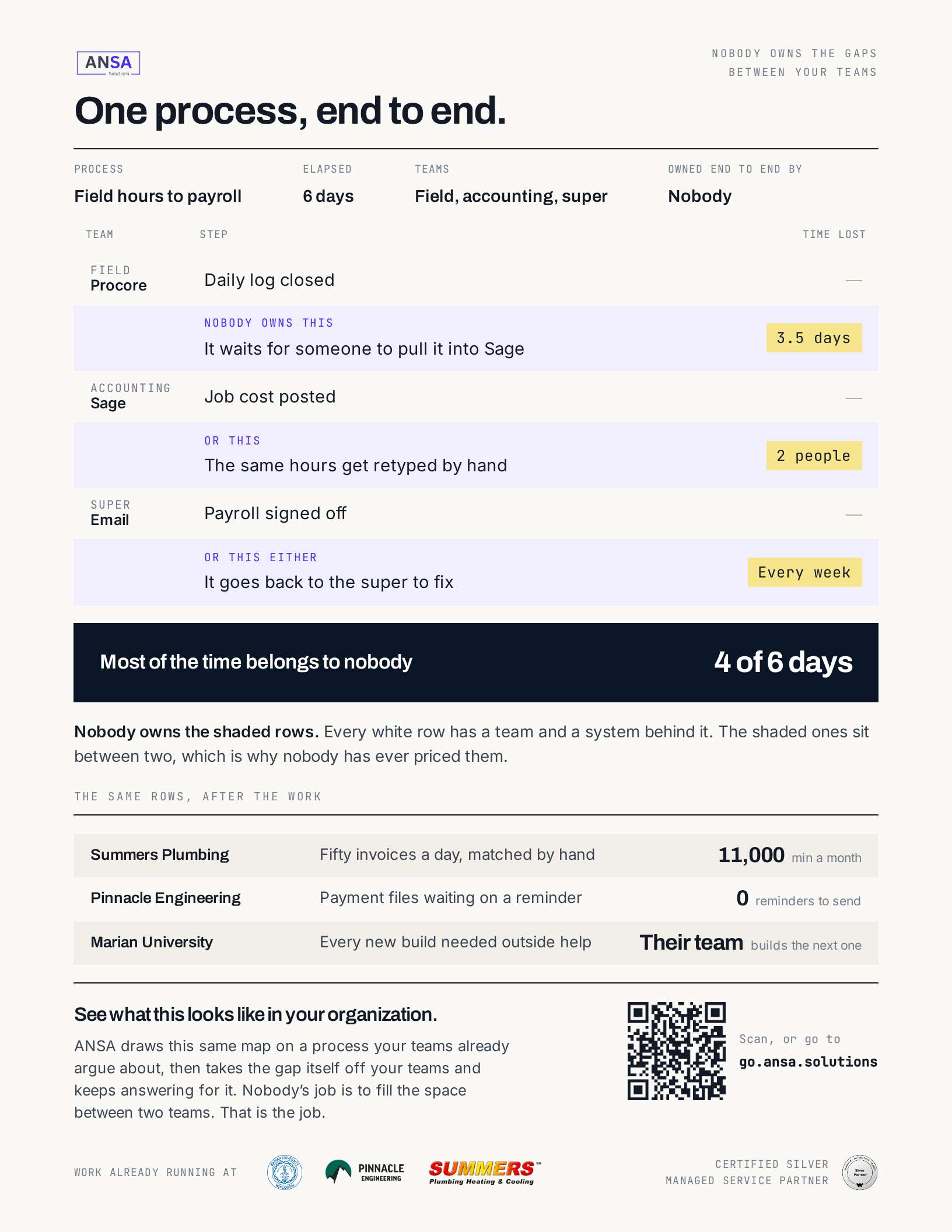
Reads on its own, for anyone on your team who has not seen this page.
Download the one page